
How is the laying on of hands a foundational doctrine from Hebrews 6:1-2? Well, back in the New Testament times, it seems like people had quite a good understanding that this was something important.
Mark 5:22-23
And behold, one of the rulers of the synagogue came, Jairus by name.
And when he saw Him, he fell at His feet and begged Him earnestly, saying, “My little daughter lies at the point of death.
I beg you, come and lay Your hands on her, that she may be healed, and she will live.” (KJV 2016)
The first thing we need to do is get into a Hebraic frame of mind. It makes things so much easier to understand what is happening.
Laying hands on someone is a spiritual thing, as me physically laying my hands on someone doesn’t have any physical function to heal someone like in the example above, but the concrete physical actions that are being taken help us to understand what is happening spiritually.
The Anointing
“Anointing” to me sounds like a spiritual thing, like we may not be doing anything physically at all but in fact in Hebrew this is not the case. Anointing has a clear cut physical action that you can understand.
It’s being smeared with oil.
Here is a verse demonstrating clearly what anointing looks like with the word anoint swapped for smear. You can see the Strong’s listing for “anoint” fits “to smear” perfectly, the Hebrew word “Mashach”.
1 Samuel 16:22-23
And he sent, and brought him in. Now he was ruddy, and withal of a beautiful countenance, and goodly to look to. And the LORD said, Arise, [smear] him: for this is he.
Then Samuel took the horn of oil, and [smeared] him in the midst of his brethren: and the Spirit of the LORD came upon David from that day forward. So Samuel rose up, and went to Ramah.
So this is King David, obviously he is very special. What does this have to do with us? We see something similar in the New Testament. The context of the following verse is the disciples being sent out in pairs, without money or equipment to preach.
Mark 6:12-13
And they went out, and preached that men should repent.
And they cast out many devils, and anointed with oil many that were sick, and healed them.
Ok! So this isn’t just something that we do for the extremely unique roles of the bible, the prophets, the kings but also for the people? Sort of. You are being anointed (smeared) to be extremely special.
You should be a king, Jesus (יהושוע) wants to make us kings and priests.
Revelation 1:5-6
And from Jesus Christ, who is the faithful witness, and the first begotten of the dead, and the prince of the kings of the earth.
Unto him that loved us, and washed us from our sins in his own blood,
And hath made us kings and priests unto God and his Father; to him be glory and dominion for ever and ever. Amen.
This anointing also seems to be directly connected to receiving the Holy Spirit (like David’s anointing from earlier), although it is not the only time the Holy Spirit is received.
Acts 19:4-6
Then said Paul, John verily baptized with the baptism of repentance, saying unto the people, that they should believe on him which should come after him, that is, on Christ Jesus.
When they heard this, they were baptized in the name of the Lord Jesus.
And when Paul had laid his hands upon them, the Holy Ghost came on them; and they spake with tongues, and prophesied.
Being Holy (Set Apart)
This action of taking oil and smearing it on someone, would have likely been a lot more evident to people of the past. In Israel, their oil came from olives, but even now harvesting olives for genuine extra virgin olive oil to this day continues to be an expensive, highly demanded product (so valuable it’s often counterfeited).
And thinking in our Hebraic action-pictures, the Bible shows the expensive, precious oil representing the Holy Spirit. Here is the 7-stemmed lamp (minorah) from Israel’s instructions for the Tabernacle
Leviticus 24:1-2
And the LORD spake unto Moses, saying,
Command the children of Israel, that they bring unto thee pure oil olive beaten for the light,
to cause the lamps to burn continually.
We can connect these lamps and oil directly to the Holy Spirit.
Revelation 4:5
And out of the throne proceeded lightnings and thunderings and voices:
and there were seven lamps of fire burning before the throne, which are the seven Spirits of God.
So when you look at all this from an ancient Israelite’s mindset, you’re taking this expensive and precious oil, and you’re pouring it on someone’s head, smearing it on them. This is a big deal.
This person is going to shine and glisten in the light with the oil covering them. This is not something your average person struggling to get by can do.
And that is the point, it is a deliberately “wasteful” action that signifies to everyone involved, that this is significant.
Matthew 26:6-10
Now when Jesus was in Bethany, in the house of Simon the leper,
There came unto him a woman having an alabaster box of very precious ointment, and poured it on his head, as he sat at meat.
But when his disciples saw it, they had indignation, saying, To what purpose is this waste?
For this ointment might have been sold for much, and given to the poor.
When Jesus understood it, he said unto them, Why trouble ye the woman? for she hath wrought a good work upon me.
The Anointed One (Smeared One)
But it goes even deeper than that. The very word used in the Hebrew for Jesus (יהושוע) signifies the anointing (smearing).
Hebrews 1:8-9
But unto the Son he saith, Thy throne, O God, is for ever and ever:
a sceptre of righteousness is the sceptre of thy kingdom.
Thou hast loved righteousness, and hated iniquity;therefore God, even thy God, hath anointed thee with the oil of gladness above thy fellows.
This verse is a quote from Psalms 45:7 and the Hebrew version of this quote gives us our original word “mashach” again, that is to anoint/smear.
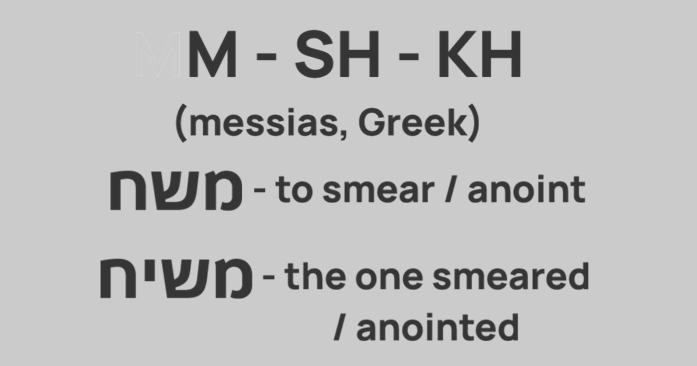
If we go looking for this word elsewhere we find something interesting in the prophecy in Daniel about the rebuilding of the temple, the crucifixion, and destruction of Jerusalem. There’s a very similar word used, it is translated as “Messiah”.
Daniel 9:26
And after threescore and two weeks shall Messiah be cut off,
but not for himself: and the people of the prince that shall come shall destroy the city and the sanctuary;
and the end thereof shall be with a flood, and unto the end of the war desolations are determined.
This word for “Messiah” actually is actually what gets transliterated into the Greek, to show us what “Christ” or the Greek word “christos” actually means.
John 1:41
He first findeth his own brother Simon, and saith unto him, We have found the Messias, which is, being interpreted, the Christ.
This is amazing because this verse shows us the disciples were actively looking for “The Smeared One” or “Mashiach”. This was a known doctrine at the time of the gospel of John occurring, at least for a group of Israelites.
This is how “Messiah” is translated from the Hebrew and Greek.
Note that Greek words typically end with strict rules, so ending in an “s” even for a transliterated word is not unusual.
The Anointing (Smearing) That Heals
When you are anointed, you are set apart for a special purpose. This is the Hebraic understanding of the word “holy”. Smearing you with oil is a physical representation of receiving the Holy Spirit, which makes you holy, set apart, or simply put, special.
We can see this was done with both the holy objects in the Tabernacle and with the priests.
Exodus 28:41
And thou shalt put them upon Aaron thy brother, and his sons with him; and shalt anoint them, and consecrate them,
and sanctify them, that they may minister unto me in the priest’s office.
Aaron and his sons were set apart, they were special. Separated from that which is normal and common for God’s special purposes. They did the work of the Tabernacle and the Temple, they were supported by the children of Israel with tithes so that they could eat while spending their time in God’s work for the entire congregation as a whole to benefit.
But this picture of a special group is for us right now, we live in a world where nothing is special, nothing is set up to do it God’s way. We are called to be set apart (holy), to leave the ways of this world and be an example to the people around us.
This is why we saw the disciples going around anointing people, not just to heal them physically, but to heal the faith of the people as a whole.
James 5:14-16
Is any sick among you? let him call for the elders of the church;
and let them pray over him, anointing him with oil in the name of the Lord:
And the prayer of faith shall save the sick, and the Lord shall raise him up;
and if he have committed sins, they shall be forgiven him.
Doesn’t really seem like we’re just talking about a physical sickness here, and that’s because calling back our Hebraic picture, a physical sickness can teach us what being spiritually sick is like. When we are physically sick, it’s an important reminder for us to think about where we stand with God.
If my body gave out today, am I living in faith? We have a King Hezekiah giving us a powerful example of just that.
2 Kings 20:1-7
In those days was Hezekiah sick unto death. And the prophet Isaiah the son of Amoz came to him, and said unto him, Thus saith the LORD, Set thine house in order; for thou shalt die, and not live.
Then he turned his face to the wall, and prayed unto the LORD, saying,
I beseech thee, O LORD, remember now how I have walked before thee in truth and with a perfect heart, and have done that which is good in thy sight.
And Hezekiah wept sore.
And it came to pass, afore Isaiah was gone out into the middle court, that the word of the LORD came to him, saying,
Turn again, and tell Hezekiah the captain of my people, Thus saith the LORD, the God of David thy father, I have heard thy prayer, I have seen thy tears:
behold, I will heal thee: on the third day thou shalt go up unto the house of the LORD.
And I will add unto thy days fifteen years; and I will deliver thee and this city out of the hand of the king of Assyria; and I will defend this city for mine own sake, and for my servant David’s sake.
And Isaiah said, Take a lump of figs. And they took and laid it on the boil, and he recovered.
Hezekiah gets healed! But wait, right after this he asks God for the sign of his healing (that is to say, the confirmation that it will happen). For the healing that he had just received? What’s going on?
2 Kings 20:8
And Hezekiah said unto Isaiah,
What shall be the sign that the LORD will heal me, and that I shall go up into the house of the LORD the third day?
Now we know we aren’t talking about a physical healing. Hezekiah is already physically healed. We’re talking about salvation, being raised at the “third day” is a reference to the second coming of Jesus (יהושוע), after 2,000 years have completed and the third, 1,000 years has started. This is the “third day”.
2 Peter 3:8
But, beloved, be not ignorant of this one thing,
that one day is with the Lord as a thousand years, and a thousand years as one day.
God sends us His Word to heal us. We get in trouble, our family, our friends, our nations have become entangled in the world, forsaking the ways of God. We are sick, we are enslaved and ensnared by the idols of this world… But God gives us a way out.
His Word is healing. His Word is your guarantee of life. I’m not saying you won’t ever be physically ill, but I am saying that you too can be raised like King Hezekiah at the third day.
Psalms 107:19-20
Then they cry unto the LORD in their trouble, and he saveth them out of their distresses.
He sent his word, and healed them, and delivered them from their destructions.
Support and Burdens
There’s another part to this laying on of hands that we can see through our Hebraic pictures. We know the olive oil is special, being our representation of the Holy Spirit, but you can put oil on someone without touching them. Why do we want to lay our hands on someone?
Take a look at the Hebrew word “samach”, which signifies laying something on, as in giving it a burden to carry or the supporting of someone, holding them up.
“Samach” means both of these, which isstandard word usage in Hebrew because the word derives from the action, and the action here is essentially the same. Somone “carries your burden”, or you “carry” them and their burden.
It is very common for Hebrew to use both sides of the action, within the same word. The word for “teach” is the same as the word “to learn“.
Here’s a Hebraic picture of a burden being carried.
Leviticus 4:3-4
If the priest that is anointed do sin according to the sin of the people;
then let him bring for his sin, which he hath sinned, a young bullock without blemish unto the LORD for a sin offering.
And he shall bring the bullock unto the door of the tabernacle of the congregation before the LORD;
and shall lay his hand upon the bullock’s head, and kill the bullock before the LORD.
What is the priest doing? He’s laying the burden of his sin, on this innocent animal to “carry it”, and sacrificing the animal to cover for the lawfully required punishment (judgment) of the sin. And this is using exactly our Hebrew word “samach”. This is different than forgiving the sin.
Numbers 8:9-10
And thou shalt bring the Levites before the tabernacle of the congregation: and thou shalt gather the whole assembly of the children of Israel together:
And thou shalt bring the Levites before the LORD: and the children of Israel shall put their hands upon the Levites:
Again, “samach”, I think not only are the children of Israel setting apart the Levites as holy unto God, but also giving them the burden of bearing them as a people before God. And the rest of the Bible shows this wasn’t an easy job, because Israel often neglected their priests (lacking tithes exemplified in Malachi 3:8-11, although note this is not money, it’s food).
The high priest literally goes into the Tabernacle to cover over the sins of the people every year (an appointed time of the LORD that we should continue to keep). This was not a casual job, the rest of Leviticus 16 shows the many steps required to do this.
Leviticus 16:1-2
And the LORD spake unto Moses after the death of the two sons of Aaron, when they offered before the LORD, and died;
And the LORD said unto Moses, Speak unto Aaron thy brother, that he come not at all times into the holy place within the vail before the mercy seat,
which is upon the ark; that he die not: for I will appear in the cloud upon the mercy seat.
This carrying of a burden is also reflected by two directly related Hebrew words (this is a standard way to analyze Hebrew words through their overlapping letters or roots).
- “Nasa”, the verb “to carry or lift”, typically the word used to translate “forgiveness”
- “Nasi” used for all types of leaders, authorities but also notably for the 12 tribes of Israel and for the high priest in Ezekiel 45
Here we see a word for “carrying” overlapping with the word for “a person who carries burdens” which is a word for “leader”). God built the Hebrew language from the ground up for us to be able to see things like this.
Now remember how I said you were being anointed (or smeared with oil) to be a king and a priest? Well, kings work a bit differently in the Bible compared to the world. The significance here is that kings and priests are expected to forgive (carry) the sins of the people.
To make this clear, your anointing makes you precious and special before God. And in walking this out, you will carry the sins of the people around you in just the way that the high priest of Israel used to (and will in the future) carry the sins of the people.
Luke 22:25-27
And He said to them, “The kings of the Gentiles exercise lordship over them, and those who exercise authority over them are called ‘benefactors.’”
But you shall not be like this; but rather, he who is greatest among you, let him be as the younger, and he who rules as he who serves.”
Because, who is greater, he who sits at the table, or he who serves? Is it not he who sits at the table? Yet I am among you as He who serves.” (KJV 2016)
But I want to immediately make it clear, this is not truly burdensome work, this is the blessing of God if you are ever in the position to do this for people. This is what being a good pastor is, you look after the sheep that frustratingly wander off, into danger despite your best efforts, and you are going to have to run off and rescue them.
And then they’ll probably do it again. But we have the other side of “samach”, that is, the support of God.
The Support of God
All the highlighted words below are the Hebrew word “samach”, used to signify support, upholding, something you can lean on.
Psalms 145:14
The LORD upholdeth all that fall, and raiseth up all those that be bowed down.
Psalms 3:3-4
I cried unto the LORD with my voice, and he heard me out of his holy hill. Selah.
I laid me down and slept; I awaked; for the LORD sustained me.
2 Chronicles 32:8
With him is an arm of flesh; but with us is the LORD our God to help us, and to fight our battles. And the people rested themselves upon the words of Hezekiah king of Judah.
Bringing It All Together
So we have our three actions that come together to teach us about this instruction of “laying on of hands”, an anointing or smearing of oil which can give the Holy Spirit.
The laying on of the burden of sin that needs to be covered, carried and forgiven. And finally, the support of God. All this comes together to teach us about how Jesus (יהושוע) first and foremost, was completely set apart, the most unique of us all.
He was anointed by the Holy Spirit, set apart with the oil, bore the burden of our sins in the crucifixion. He is the Most Holy, the most set apart. But we are also called to be holy, and set apart and walk like He walked.
Leviticus 11:45
For I am the LORD that bringeth you up out of the land of Egypt, to be your God:
ye shall therefore be holy, for I am holy.
Can We Lay Hands on People?
I think that is why this is indeed a fundamental doctrine, when we take all these learnings of what the laying on of hands teaches us, the holiness we are called to and that by walking in this holiness, we can heal others, we can set them apart for the kingdom of God through the laying on of our hands.
1 Timothy 4:14
Do not neglect the gift that is in you, which was given to you by prophecy with the laying on of the hands of the eldership.
But it is serious, and it is to be taken seriously.
1 Timothy 5:22
Lay hands suddenly on no man, neither be partaker of other men’s sins: keep thyself pure.
I think we should be trying to lay on hands, but with lots of diligence. I encourage you to seek God’s wisdom directly on the matter, through your Bible and His actions in your life. As Paul told Timothy, don’t do it in haste.
But to me it seems we do need to be healing the people, setting them apart for God’s purpose. All those who decide to heed the call that God has given us with this profound and important action. Even calling it a basic doctrine, and we should be striving to use it to bless others as best we can, with all the wisdom and discernment we can muster.
It is quite a statement calling this basic doctrine but it reminds us that our current world is not operating in the way that God intended, and that He didn’t leave us, but we left Him.
So let us return to Him with our whole hearts, seeking Him and serving others, loving them as ourselves. And when we can, when someone is willing to accept the burden (not of the LORD, but of others), perhaps we can lay our hands on them, setting them apart as holy, healing them, and blessing them as God wills it.
Do everything in faith, seek the lessons of your Bible as you go out with this new learning and keep watch in your life over the precious instructions we’ve received. May you be upheld by God’s mighty hand.
Genesis 48:14-16
And Israel stretched out his right hand, and laid it upon Ephraim’s head, who was the younger, and his left hand upon Manasseh’s head, guiding his hands wittingly; for Manasseh was the firstborn.
And he blessed Joseph, and said, God, before whom my fathers Abraham and Isaac did walk, the God which fed me all my life long unto this day,
The Angel which redeemed me from all evil, bless the lads; and let my name be named on them, and the name of my fathers Abraham and Isaac; and let them grow into a multitude in the midst of the earth.
Mark 16:15-18
And he said unto them, Go ye into all the world, and preach the gospel to every creature.
He that believeth and is baptized shall be saved; but he that believeth not shall be damned.
And these signs shall follow them that believe; In my name shall they cast out devils; they shall speak with new tongues;
They shall take up serpents; and if they drink any deadly thing, it shall not hurt them; they shall lay hands on the sick, and they shall recover.
Praise God! Amen ve’amen.